
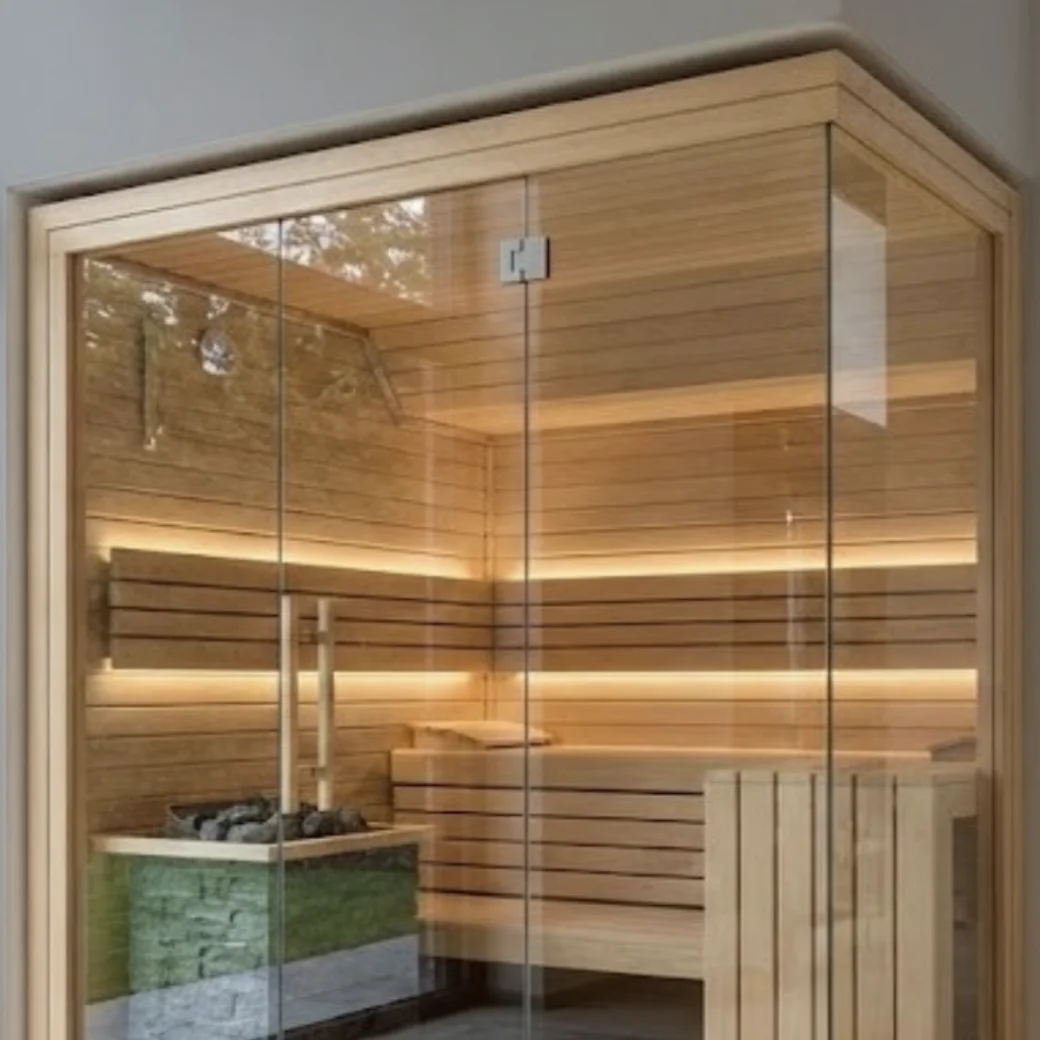
The science
behind the wood.
What a sauna asks of its wood, why the inside is natural Canadian red cedar and the outside is heat-treated mahogany, and what that means for how it feels, how long it lasts and what it costs to run.
What a sauna
asks of its wood.
A sauna is heated to 80–90°C and cooled again every session, with water on the stones, in Indonesia’s heat and humidity. The wood that does this best does four things.
Stays cool to touch
Light wood holds more air in its cells, so it passes heat to your skin slowly.
Holds the heat in
The less heat the walls let through, the less the heater has to make.
Barely moves
Wood that takes up little water doesn’t swell, shrink, warp or split.
Resists rot
Without paint, varnish or preservative that would heat up and give off fumes.
Western red cedar,
clear grade.
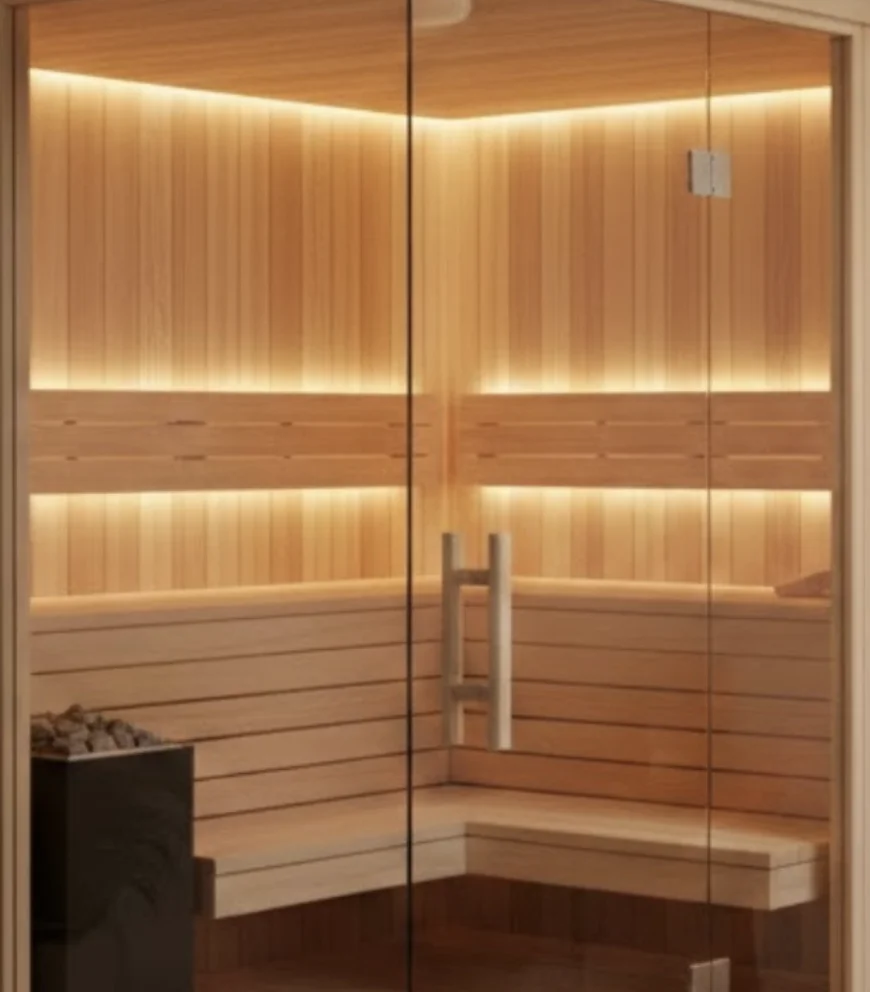
Western red cedar grows in the forests of Canada’s west coast. Sozen imports it in clear grade, the top grade of red cedar: boards with no knots. Knots are denser than the wood around them, so they run hotter, and they can crack or leak resin in the heat.
At 380 kg a cubic metre it is a light wood, which is why a cedar bench at 85°C feels far cooler than a dense hardwood at the same heat. It is left untreated and fully natural: its own oils, the source of its scent, resist rot, fungus and termites, so it needs nothing on it, and the room keeps the smell of real cedar. And it barely moves: from green to 12% moisture it shrinks 1.2% one way across the grain and 2.6% the other, a very low figure, so the boards stay tight.
- Grade
- Clear: the top grade of western red cedar, with no knots
- Price
- On average twice the price of knotty cedar, the lower grade: $8–12 a square foot for clear, against $4–6
- Weight
- 380 kg a cubic metre at 12% moisture
- Durability
- Class 2, durable: 15–40 years above ground, out in the weather, with no treatment; termite resistant. Class 1 is the top: yellow cedar, the other choice inside, is class 1
- Movement
- 1.2% radial and 2.6% tangential shrinkage, from green to 12% moisture
Thermo-mahogany:
heat, not chemicals.
The outside is not cedar. It takes the rain and the sun, so it is clear-grade mahogany (meranti), a harder-wearing wood, thermo-treated: heated to 180–200°C in a vacuum kiln, and nothing added. With no air inside the kiln the wood cannot catch fire, which is what lets it take that heat. The cedar inside is not treated at all. Sozen does this itself, which no other company in Indonesia does.
Dried
The wood is warmed and dried until almost no water is left in it.
Heat-treated
It is held at 180–200°C in a vacuum. The heat breaks down the sugars in the wood, the part that takes up water and that rot feeds on.
Cooled and settled
It is cooled and brought back to a working moisture, ready to cut.
Takes up less water
It holds much less moisture than untreated wood, so it swells and shrinks far less.
Lasts longer outdoors
With the sugars gone, rot has less to feed on.
An even colour
Right through the board, with no chemicals in it.
180–200°C,
in a vacuum.
Every maker dries its wood, most in an ordinary kiln: hot air at 38–82°C, too low to change the wood itself, so in damp air it takes the water back. Even a high-temperature kiln, used mostly for pine, runs at 110–121°C. Sozen treats the mahogany for the outside in a vacuum kiln at 180–200°C: 98–118°C hotter than an ordinary kiln. With no air in the kiln, the wood cannot catch fire, so it can be taken to a heat that would burn it in an ordinary kiln, evenly, right through the board. No other sauna in Indonesia is made this way: sozen is the only importer of this wood in Indonesia, and the only company here with the machine for this process.
Cedar against
sungkai.
Red cedar against sungkai, the wood many saunas in Indonesia use inside. Each figure is on average, for dried wood and a 40 mm wall.
| Western red cedar | Sungkai | |
|---|---|---|
| Weight | 380 kg/m³Red cedar 41% lighter than sungkai | 640 kg/m³ |
| How it conducts heat | 0.096 W/m·K | 0.16 W/m·K |
| Heat lost through a 40 mm wall | 40% less than sungkai2.4 W per m² per °C, against 4.0 | The most4.0 W per m² per °C |
| Wood to warm up | 15.2 kg per m² of wall | 25.6 kg per m² of wall |
| Durability class, above ground | Class 2, durable: 15–40 years | Moderately durableClass 3 of 5 on Indonesia’s own scale; usually treated for damp |
| On the skin at 85°C | Cooler | Hotter |
| Outside: what heat treatment does | Untreated wood | Thermo-treated |
|---|---|---|
| Moisture it holds | 100 | Down to 50 at 220°CUp to half |
| Heat it lets through | 100 | 75–8020–25% less |
| Durability outdoors | Depends on the wood | Durable, for outdoor cladding (Thermo-D) |
The ThermoWood handbook’s figures for heat-treated wood, with untreated wood as 100.
What it means
to run one.
Once a sauna is hot, the heater’s job is to replace the heat that escapes, much of it through the walls. On average, red cedar lets 40% less heat through than sungkai, and a square metre of red cedar wall has 41% less wood to warm up. So the room comes up to heat sooner, the heater runs less to hold it, and it uses less power every session. And cedar is rated more durable than sungkai: red cedar is class 2, durable, and yellow cedar class 1, the top.
Heats sooner
Less wood to warm up in every wall.
Costs less to run
Less heat through the walls, so less work for the heater.
Lasts longer
Red cedar is rated durable, 15–40 years above ground; sungkai only moderately durable.
Never alone. With a heart condition, high blood pressure or pregnancy, talk to a doctor first.
Sources: Sozen, October 2026, and Sozen’s product catalogue, January 2026 (the clear grade from Canada, the cedar left natural, the mahogany outside, vacuum kiln-dried and heat-treated at around 200°C, the 40 mm walls). Queensland Government, Properties of timbers (western red cedar 380 kg/m³, durability class 2, termite resistant; above-ground life by class, Australian Standard AS 5604: class 1 over 40 years, the top; class 2 15–40 years). Forests, 2023, MDPI (sungkai 0.64 g/cm³ air-dry, class 3, moderately durable); Borneo Science, 2016 (class III on Indonesia’s own scale of I to V). The USDA Forest Products Laboratory, Wood Handbook (thermal conductivity at 12% moisture from specific gravity: 0.32 for red cedar and 0.58 for sungkai; heat through 40 mm is that figure divided by 0.04 m; wood to warm up is the weight times 0.04 m). The USDA Forest Products Laboratory, Dry kiln schedules for commercial woods, FPL-GTR-57, 1988 (conventional kilns 38–82°C, high-temperature kilns 110–121°C). The International ThermoWood Association, ThermoWood handbook, April 2021 (the three steps, steam, up to half the moisture held at 220°C, 20–25% less heat through, Thermo-D rated durable for outdoor cladding). Western Red Cedar Lumber Association, realcedar.com (shrinkage from green to 12%: 1.2% radial, 2.6% tangential). Tahoe Sauna Company, Western red cedar for saunas, June 2026 (clear $8–12 and knotty $4–6 a square foot).
The saunas are Sozen’s; Kaido sells them and looks after you. Figures checked on 30 October 2026.